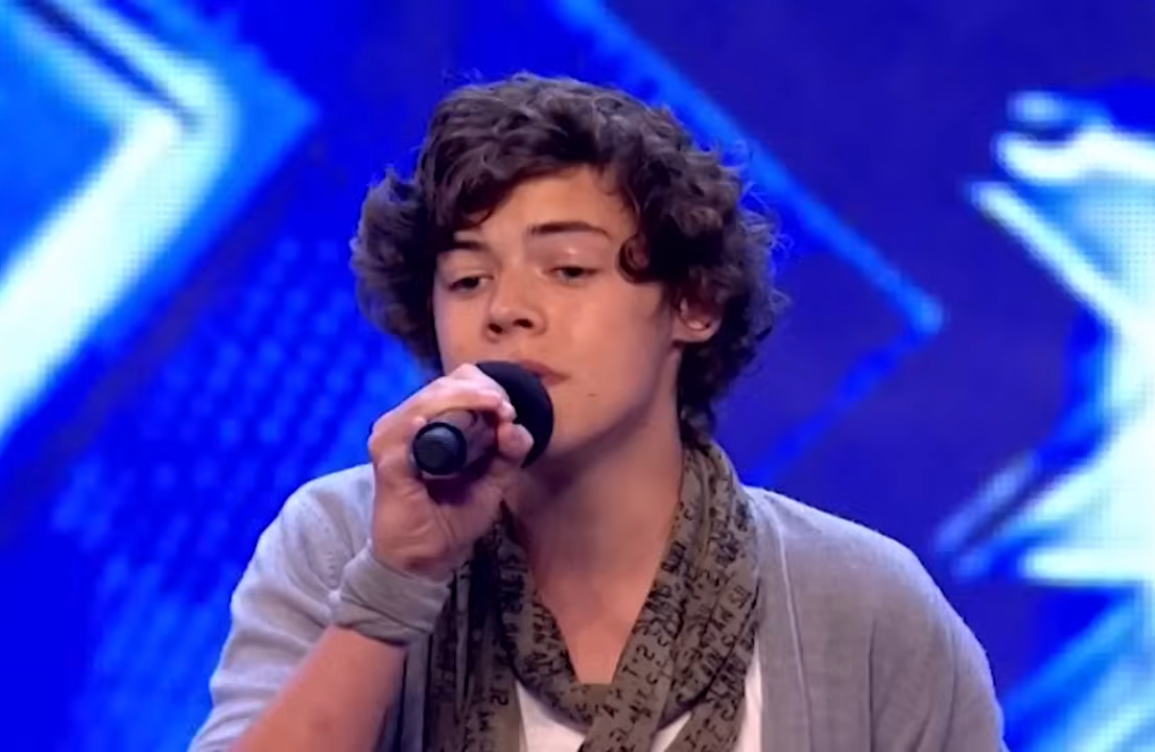
The boy who served cakes
Harry Styles is 16, from Holmes Chapel in Cheshire, and he works Saturdays in a bakery. When the judges ask what sells well, he rattles off Viennese fancy, millionaire shortbread, big salad. When they ask what’s going down, he says white coburg, a white loaf with a cross on top. He’s just finished his GCSEs and is heading back to college in September to study law, sociology, and business. He’s in a band called White Eskimo. He won a battle of bands competition a year and a half ago, and the thrill of singing to a crowd is what pulled him toward this stage.
“People tell me I’m a good singer,” he says. “It’s usually my mom.” The judges laugh. He’s not performing confidence. He’s performing a 16-year-old who wants an answer from people who actually know. He sings “Hey Solstice” by Train, stumbles, and the judges ask for something a cappella. He switches to “Isn’t She Lovely” by Stevie Wonder, and the room goes quiet. Louis says no. “I don’t think you’re gonna…” He doesn’t finish. The audience boos. Louis adds, “Actually, I don’t think they booed you loud enough there.” Harry gets through on three yeses.
The bed-sit and the twenty-two years
James Arthur is 24, from Salt burn near Middlesbrough, and he lives in what he calls “more like a bed-sit than a flat.” His parents split when he was young and stopped speaking for his entire life. He went off the rails at school, got suspended, threw himself into foster care to escape the arguing. Music was a coping mechanism. He writes about mistakes in his past, broken hearts, looking for a crutch, living fast and dying a legend. His mom, sitting in the audience, says the lyrics are “deep stuff” and that sometimes she wonders, “Have I done enough? Did I do enough?”
On the day of his audition, his mom and dad are in the same room for the first time in twenty-two years. They agreed, before walking in, that regardless of whatever came before, they would move forward. James brought both sides of the family together. He sings Talisa’s song, but his own version, on acoustic guitar. Simon Cowell says, “If anyone dares touch what you do, because it’s so good.” He calls it the best audition of the day. Four yeses. James says it means “the absolute world” to him. His mom, in the audience, says, “My son’s an Ibiza dance track, and he’s turned it into that. That was brilliant. That’s why I said I wanna write a song. Just see what he does with it.”
The receptionist and the vocal gymnastics
Leona Lewis is from Hackney, North London. She works part-time as a receptionist. Her dad is a DJ, her mom is a dancer. She walks up and says she’s going to sing “Over the Rainbow.” She does. The judges are split. Lulu says she’s got “the whole package.” Simon says it wasn’t perfect because she fell off the melody at certain points, but when it was on, it was “absolutely fantastic.” Then he gets specific. He tells her she has a great voice and he’d prefer it without “all the little… on your voice.” He calls it vocal gymnastics. “The American cliche,” he says. “Less is more.” She gets four yeses. In the green room, she’s calm, almost in shock. “I kind of should be screaming and stuff,” she says. “I’m just kind of in shock of it.”
The brother who sang goodbye
Callum is 26, from Hull. He’s Jade’s brother. His sister didn’t get through, and she’s sitting right beside him in the audience. He sings “Dancing on My Own” by Robyn, slowed down. The lyrics are about being in the corner, watching someone kiss another person, giving them your all, not being the one they take home. “I just came to say goodbye,” he sings. Simon says he’s never, in all the years he’s done the show, heard a guy with that talent. “You’re more than a singer. You’re an artist.” Cullum gets through. His sister is there for the moment, and he thanks her by name.
The ones who didn’t make it, and the ones who came back
Not every story in this video ends with four yeses. A farm girl steps up, and the judges cut her off mid-song. A 47-year-old receptionist walks in wanting to be a singer, and the room shifts. Someone who was rejected three years ago is back on that same stage, and the judges remember her name. A 12-year-old sings a song she wrote herself, and it’s about her. The audience laughs at one point, and then no one is laughing.
These auditions are not performances. They are 24-year-olds in bed-sits, 16-year-olds in bakeries, receptionists from Hackney, brothers standing beside sisters who didn’t make it. They are people who volunteered themselves into foster care to stop the arguing, who won a battle of bands in a small Cheshire town, who told their parents to stop speaking for twenty-two years and then brought them back into the same room for one song.
The video runs over fifty minutes. You’ll hear the stumbles, the boos, the mom in the audience saying “I’m like, really? No. No. No joking.” You’ll hear Simon say “less is more” to a girl who just sang “Over the Rainbow” and got four yeses anyway. You’ll hear a 16-year-old name the bakery’s best-seller and worst-seller with the same flat confidence he brings to Stevie Wonder. You’ll hear a dad say “I’m his dad. There we go” like he’s confirming a reservation.
Watch it. Not for the superstars you already know. For the bed-sit, the bakery, the twenty-two years of silence, and the one song that broke it open.
